
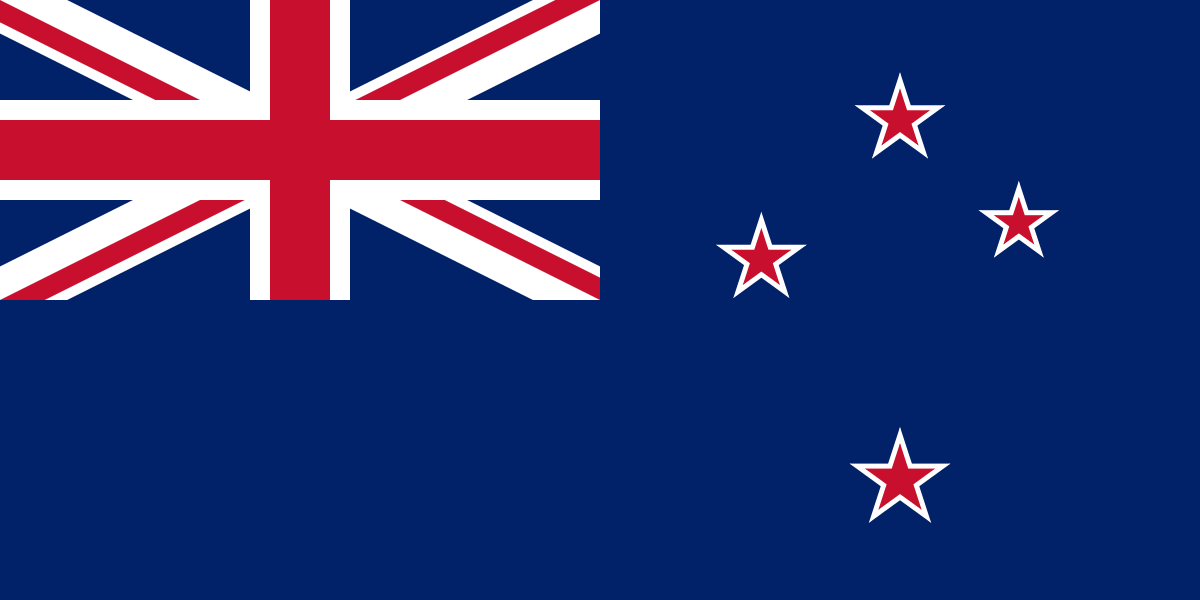
New Zealand at a Glance
Here’s where you get started with human resources best practices and hiring in New Zealand.



Currency of New Zealand
New Zealand Dollar (NZD)

The Capital of New Zealand
Wellington

Time Zone in New Zealand
GMT+12
Important Facts
Important Facts About the Country of New Zealand
Introduction to New Zealand
New Zealand is a small country with a big heart. It has a unique history, a vibrant culture and there’s so much to do – much of it outdoors in its famously beautiful natural scenery.
What to Know about New Zealand’s Geography
New Zealand is an island nation located in the southwestern Pacific Ocean. It consists of two main landmasses—the North Island and the South Island—as well as approximately 600 smaller islands.
Climate in New Zealand
New Zealand generally enjoys a mild climate, with winds coming in from the coast. The temperature usually gets colder as you head south.
The Culture of New Zealand
New Zealand is a wealthy Pacific country dominated by two cultural groups: the New Zealanders of European descent and the Maori, who are the descendants of Polynesian settlers.
Religions Observed in New Zealand
Around half of New Zealand’s population identifies with no religion, making it the largest religious category. Christianity remains the largest organized religion, followed by smaller but growing communities of Hindus, Muslims, Buddhists, Sikhs, and other faiths.
Languages Spoken in New Zealand
English is spoken by 96.1% of the New Zealand population and is used in parliament, government, courts and the education system.
Maori is used by New Zealand’s indigenous population. As per the Maori language Act 1987, it can be used for legal settings but proceedings are recorded in English.
Tax and Social Security Information for Employers in New Zealand
Personal Income Tax in New Zealand
Social Security
| Income Thresholds (NZ) | Tax Rate % |
|---|---|
| 0 – 15,600 | 10.5 |
| 15,601 – 53,500 | 17.5 |
| 53,501 – 78,100 | 30 |
| 78,101 – 180,000 | 33 |
| >180,000 | 39 |
Workers Compensation Insurance
The Accident Compensation Corporation (ACC) is the provider of accident insurance for all work and non-work-related injuries in New Zealand. Employers are legally required to pay ACC Work Account levies for all employees — whether full-time, part-time, or casual — based on their liable earnings. The levy rate varies depending on the industry risk classification. Employers may receive a discount (or surcharge) under ACC’s Experience Rating system, based on their claims history over the past three years. As of April 1, 2025, the average employer levy is 0.66% of liable earnings. In addition, a separate Earners’ Levy of 1.67% is deducted from employees’ earnings via PAYE to fund cover for non-work-related injuries.
Superannuation Contribution (kiwisaver)
The New Zealand Superannuation and Retirement Income Act 2001 governs the voluntary superannuation to all employees. The New Zealand KiwiSaver is not a compulsory scheme and employees can opt out. All employees are automatically enrolled and if they do not opt out, then both employer and employee are required to contribute.
The employer is required to pay 3% of an employee’s salary to their KiwiSaver account. The rate of superannuation anyone is entitled to depends on a number of factors like marital status, living status and whether the employee lives with other people.
Effective July 1, 2025, the government KiwiSaver contribution will halve, reducing the maximum government contribution from $521.43 to $260.72 each year. Also, people who earn more than $180,000 of taxable income in a year will no longer qualify for government contributions.
There’ll be no change to government contributions for the year ending 30 June 2025. These will be paid in July and August at the current government contribution rate.
Supplemental Benefits
In most cases, New Zealand employers do not provide extensive non-cash supplemental benefits (aside from bonuses) due to the impact of Fringe Benefit Tax (FBT), which can make such benefits costly. Employees generally do not expect these types of benefits. However, certain minor benefits may be provided tax-free under the FBT “de minimis” exemption, which allows unclassified benefits up to $300 per employee per quarter (subject to a $1,200 annual total across all staff).
Employers may also choose to take out Employers Liability Insurance, which is a voluntary business insurance product. It protects employers against certain legal claims for work-related injuries or illnesses that fall outside ACC coverage. This insurance does not attract FBT, as it is not a benefit provided to employees directly.
*The above rates serve as a broad guideline. Actual rates charged by GoGlobal will differ.
Important Information for New Zealand Employees
Salary Payment
The employee’s salary can be paid on a weekly, fortnightly or monthly basis. Employers need to pay employees their final payment on the last day of work, unless agreed otherwise in writing.
Payslip
Pay slips are not compulsory in New Zealand. Pay slips can be electronic or hardcopy, containing details of payments, deductions and superannuation contributions for each pay period.
Annual Leave
- Full-time and part-time employees are entitled to four weeks of paid annual holidays after 12 months of continuous employment. Employees who have worked less than one year are not entitled to any annual leave although employers may let them take some leave in advance. Employers can offer more annual leave than the minimum required by the National Employment Standards (NES).
- Employees can ask to cash out up to one week of their annual holidays each year.
- Annual leave accumulates in hours and from the first day of employment, including the probation period. Unused annual leave will roll over from year to year and is paid out upon termination of employment.
- All employees in New Zealand are required to use the GoGlobal leave tracking system. This enables us to determine leave accrued and latest leave balance, timely and accurately, so that employees are updated on their leave entitlements.
Sick Leave
- Sick leave allows employees to take time off leave to care for a sick or injured spouse, partner, dependent child or any other dependent individual.
- This type of leave is funded by the employer. Access to sick leave applies after 6 months of continuous employment with the current employer, and an employee is entitled to 10 days of paid leave per year.
- Employers may request proof if an employee is sick for three or more consecutive days but the employer must agree to pay for the doctor’s fee.
- Any leave unused can, by way of the employment contract, be carried forward to the next year with the maximum capped at 20 days or more if the employer so chooses.
Compassionate & Bereavement Leave
- All employees are entitled to three days’ paid compassionate leave (bereavement leave) and can be taken if their partner, parent, child, sibling, grandparent, grandchild or their partner’s parent dies. The entitlement is available after the employee has been working continuously for six months and is entitled every 12 months.
- Employees are also entitled to one day upon the death of a person outside their immediate family (depending on the circumstance).
- Employees can take the leave days in advance if mutually agreed to by the employee and the employer.
- Employers can request evidence such as a funeral notice, death notice or statutory declaration.
Family & Domestic Violence Leave
- Owing to the Domestic Violence – Victims’ Protection Act 2018, employees in New Zealand have a statutory right to up to 10 days of paid domestic violence leave each year after completing six months of continuous employment. This leave supports those experiencing violent, threatening, or abusive behaviour by someone close to them that is intended to control and causes harm or fear.
- Importantly, employees are eligible even if the domestic violence occurred before they joined their current employer. They may also request short-term flexible working arrangements for up to two months to help manage their situation.
Maternity & Parental Leave in New Zealand
Parental leave may be taken when an employee gives birth, their partner gives birth, or when they adopt a child under six years of age.
Employees who have worked an average of at least 10 hours per week for 12 months before the baby’s due date or adoption date are entitled to:
- 26 weeks of government-funded paid parental leave, and
- A further 26 weeks of extended unpaid leave, totalling up to 52 weeks of leave.
Those who have worked at least 10 hours per week for six months are entitled to:
- 26 weeks of paid parental leave, and
- Up to 26 weeks of unpaid leave.
Partners (including same-sex partners) may take unpaid partner’s leave of:
- 1 week if employed for 6 months, or
- 2 weeks if employed for 12 months.
Pregnant employees are also entitled to up to 10 days of unpaid special leave for antenatal appointments or classes, prior to taking their main parental leave.
Parental Leave Payment
Public Holidays
- Each employee can enjoy a maximum of 11 public holidays a year.
- Employees enjoy a paid day off on public holidays if it’s an otherwise working day for them. If they work on a public holiday, they are paid time and a half and may enjoy an alternative day off.
- An employee is entitled to a public holiday only if the public holiday falls on a day the employee would otherwise have worked (if the day hadn’t been a public holiday).
- Some public holidays will be ‘Mondayized’ (or ‘Tuesdayized’) if they fall on a Saturday or Sunday (if those days were not days that an employee would otherwise work).
Alternative Holiday
- If an employee must work on a public holiday, an alternative holiday gives them a day off at another time. Sometimes these alternative holidays are called ‘lieu days’ or ‘days off in lieu’ but those terms can also refer to other types of leave. It is recommended to label alternative holidays by their correct name.
- If an employee is ‘on call’ on a public holiday and their activities had to be limited as a result, they are entitled to a full day’s paid alternate holiday regardless of whether the employee had to end up working that day.
Community Service Leave
- Employees can take leave for voluntary emergency management activities and jury service, including attendance for jury selection and defense force volunteer work.
- Community service leave, such as jury service, is unpaid. There is no limit on the amount of community service leave employees can take but employers can apply for the employee to be excused from such duties due to special commitments at the workplace.
- Employers do not have to pay employees while they do jury service but many choose to ‘top up’ the money the employee gets from the Ministry of Justice so they receive their normal pay.
Flexible Working Arrangement in New Zealand
Under Part 6AA of the Employment Relations Act 2000, all employees in New Zealand have the right to request flexible working arrangements at any time, regardless of their length of service.
Employers are legally required to respond to such requests as soon as possible, and no later than one month after receiving the request. If the request is declined, the employer must provide a written explanation based on one or more business-related grounds (e.g., inability to reorganise work, detrimental impact on performance, or insufficient work during proposed hours).
Flexible work can be tailored to meet both employee and employer needs. Common examples include:
- Part-time work
- Alternative start and finish times
- Remote or hybrid work
- Job-sharing
- Purchasing additional leave
- Taking additional unpaid leave
Other Types of Leave
Other types of leave include garden leave, long service leave, voting leave, jury service, defense forces leave and leave options for workplace stress or following a natural disaster.
Benefits to the Employee in New Zealand
Overtime Rates
The overtime rate can be different for each employment contract. Employees should be aware of their overtime rate to ensure they are being paid correctly. Some employers allow employees to take paid time off instead of receiving overtime pay.
New Zealand Statutory Benefits
New Zealand employment law applies equally to all workers — including citizens, permanent residents, and migrants — regardless of their visa status.
KiwiSaver, New Zealand’s voluntary retirement savings scheme, is open to:
- New Zealand citizens
- Permanent residents of New Zealand, and
- Australian citizens/residents living in New Zealand
To join, individuals must be under 65 years of age and normally live in New Zealand. People on temporary, visitor, work or student visas are not eligible to join voluntarily.
Employees are entitled to a minimum of four weeks’ paid annual leave after 12 months of continuous employment.
Other statutory leave includes sick leave, bereavement leave, and public holidays.
There is no legal requirement for employers to provide extra benefits like health insurance, although many do offer such perks voluntarily. All statutory entitlements are outlined in law and cannot be reduced by contract.
Other Benefits in New Zealand
Employers who provide non-cash benefits to employees must pay Fringe Benefit Tax (FBT) on the value of those benefits. FBT applies even if the benefit is provided to a shareholder-employee.
Examples of taxable fringe benefits include:
- Use of a company vehicle for personal use
- Employer-provided parking in high-demand or paid zones
- Gym memberships
- Low-interest or interest-free loans
- Entertainment (e.g. concert or sporting event tickets)
- Employer-paid private health or medical insurance
However, laptops, mobile phones, and other electronic devices provided primarily for business use are generally exempt from FBT. If personal use is minimal or incidental, no FBT applies.
Expatriates – Accommodation in New Zealand
Renting or buying accommodation in New Zealand is generally a safe and straightforward process. Purchasing a home can be completed in a matter of weeks. However, foreign buyers face some restrictions unless they hold New Zealand residency or meet special criteria.
Furnished long-term rentals are relatively uncommon, with most furnished properties being small (e.g., studios or one-bedroom units) and typically targeted at students or short-term renters.
Paying rent weekly is standard practice in New Zealand. Tenants are typically responsible for household expenses such as electricity, gas, water, and internet, unless otherwise agreed in the rental contract.
There are two main types of residential tenancies:
- Fixed-term tenancy – This agreement has a set start and end date. If signed after 11 February 2021, it will usually become a periodic tenancy at the end of the term unless either party takes steps to end or renew it.
- Periodic tenancy – This ongoing tenancy has no fixed end date. A tenant must provide at least 28 days’ written notice to end the tenancy, while a landlord may need to provide at least 63 or 90 days’ notice, depending on the reason for termination.
Short fixed-term tenancies (e.g., for 90 days or less) can be arranged and will not convert to periodic tenancies when they end.
Transportation in New Zealand
New Zealand’s public transportation network is limited on a national scale, particularly for long-distance rail. Intercity train services (such as the Northern Explorer and TranzAlpine) exist but are infrequent, slow, and primarily aimed at tourists, making them a scenic but less practical mode of travel.
However, intercity bus services are reliable and widely used to travel between towns and cities. Providers like InterCity cover most major destinations with relatively frequent and affordable service.
Within urban areas, public transport systems vary. Wellington and Auckland have well-developed bus and train services, while Christchurch and other smaller cities rely mainly on buses. Despite some limitations, getting around New Zealand without a private car is feasible, especially with advance planning.
Rules Regarding Visas and Foreign Workers in New Zealand
Foreign nationals who wish to live and work legally in New Zealand must obtain a valid visa through Immigration New Zealand (INZ), part of the Ministry of Business, Innovation and Employment.
The main work visa used today is the Accredited Employer Work Visa (AEWV). To qualify:
- The employer must be accredited with INZ.
- The role must meet minimum pay and skill level requirements.
- Some roles on the Green List may provide a pathway to residency.
Other work visas include:
- Specific Purpose Work Visa – for defined tasks or short-term events.
- Supplementary Seasonal Employment Visa – for onshore visa holders to work in horticulture if no New Zealanders are available.
While there are several residence pathways (e.g., the Skilled Migrant Category), all work visas are initially temporary. Applicants must meet general requirements, including:
- Health and character standards.
- (In some cases) English language proficiency.
Only some residence pathways require points-based assessments. A points-check tool is available on the INZ website, but points are officially determined only during assessment.
Visa rules are subject to change, so it’s essential to consult the official INZ site or a licensed immigration advisor.
Getting a Tax Number
Once the visa has been granted, the employee should obtain an IRD number. This is a personal tax identification number used in the New Zealand tax system.
Public Holidays Recognized by New Zealand in 2026
| Occasion | Date | |
|
1 |
New Year’s Day | January 1 |
| 2 | Day after New Year’s Day | January 2 |
| 3 | Waitangi Day | February 6 |
| 4 | Good Friday | April 3 |
| 5 | Easter Monday | April 6 |
| 6 | Anzac Day * | April 25 |
| 7 | King’s Birthday | June 1 |
| 8 | Matariki | July 10 |
| 9 | Labour Day | October 26 |
| 10 | Christmas Day | December 25 |
| 11 | Boxing Day ** | December 26 |
* Observed on April 27
** Observed on December 28
Source: New Zealand – Public Holidays
HR
New Zealand Human Resources at a Glance
Employment Law Protections in New Zealand
New Zealand’s laws are intended to help keep workplaces fair. New Zealand law applies equally to migrants, New Zealand citizens and residents. According to New Zealand employment law, employers and employees each have rights and responsibilities. Employers must treat employees fairly, pay them at least the minimum wage set by the government and meet their other employment law obligations. They must also make sure the workplace is safe. Employees must do their job competently and follow workplace health and safety rules. They must also stay within the provisions of their visa.
Employment Contracts in New Zealand
All employees must conclude a signed, written employment agreement with their employer. Even if employee has accepted a verbal offer for a job, he must sign a written agreement before he starts work. Employees can enter a collective employment agreement (negotiated by registered unions representing employees who are members of the union) or an employment contract.
A collective employment agreement is a document between an employer and their employees regarding employment conditions. Many large companies offer collective employment agreements that have been negotiated by a union. Employers must not unduly influence an employee’s decision whether to join or not join a union. A new employee who is a union member can legally agree to the terms and conditions of an existing collective employment agreement by signing an offer of employment. The collective agreement will apply even if they do not join the union. If the employee is covered by a collective employment agreement, they can also establish additional individual terms. These should be concluded in writing and signed by both the employer and employee.
An individual employment contract is an agreement between an employer and employee that establishes terms and conditions of employment. A contract must be in writing. Employment contracts cannot provide for less than the minimum legal entitlements set out in the various legislations governing employment in New Zealand. These include the Employment Relations Act 2000, Holiday Act 2003, Wages Protection Act 1983 and Minimum Wage Act 1983. among others)
If applicable, other employment conditions should be established, such as parental leave and employment protection, equal pay, health and safety at work aspect and protected disclosure.
New Zealand’s Contract Terms
Contract terms cannot provide for less than the minimum legal entitlements outlined in the legislation and collective employment agreements that may apply. All contracts must be in writing.
New Zealand’s Guidelines Regarding Probation Period/Trial Period
Probationary periods must be in the employment agreement and can be for any amount of time. During the probation period, employers must follow a fair process to give feedback, support and training throughout. Employers must also give a chance for the employee to improve. Employees may raise a personal grievance for dismissal if this process is not followed properly.
Employers with less than 20 employees can ask for a 90-day trial period from an employee, which needs to be written in the employment contract with a valid notice period. An employee cannot bring a personal grievance for unjustified dismissal or other legal proceedings about their dismissal as long as the employer has given the right amount of notice period (unless the trial period is deemed invalid by the Employment Relations Authority). Employers do not need to give reasons for dismissal.
A probationary period cannot be applied following a trial period.
Regulations and Rules Regarding Working Hours in New Zealand
The agreed number of work hours must be in the employment agreement. Working hours cannot be more than 40 hours per week (not including overtime) unless the employer and the employee agree otherwise.
New Zealand Laws Regarding Overtime
The hours agreed to in an employment agreement are generally the only hours that an employee needs to report to work. Many employees in New Zealand will receive payment if their employer asks them to work more than their normal hours.
The arrangement on overtime needs to be agreed to by the employer and the employee, whether this overtime is factored into the employee’s salary, paid at the employee’s normal rate of pay (at least the minimum wage rate or compensated at a higher rate of pay. The terms should be put into the employment agreement so that both parties are clear.
If the specific hours aren’t put into a written agreement, then an accurate and timely written record will need to be kept of exactly what hours the employee has worked.
Rules Regarding Bonus and 13th Month Pay in New Zealand
Bonuses are not required. However, many employers will offer bonuses as an incentive and for retention purposes. Bonuses differ based on industry and seniority.
Termination
Employers who want to dismiss an employee must:
1) act in good faith.
2) have a good reason for the dismissal.
3) follow a fair and reasonable process
4) have an open mind when dealing with problems so they ensure outcomes are not predetermined.
If the employer doesn’t follow above, the employee may be able to take a personal grievance claim against the employer. Reasons to dismiss an employee include:
- serious misconduct
- repeated misconduct
- performance issues
- during a trial period
- redundancy
- incompatibility
- incapacity.
There are general principles of fair process an employer must follow to justify serious misconduct, repeated misconduct and performance issues.
To terminate an employee’s employment, employers must give a written notice of the last employment day or remit a payment in lieu of notice. Serious misconduct warrants dismissal without notice. However, employers must still pay all outstanding entitlements. Disputes by both employers and employees can be referred to the Employment Relations Authority (ERA).
New Zealand’s Requirements Regarding Notice Periods
When terminating an employee, a fair and reasonable notice must be given (except in case of serious misconduct). This notice must take into account the length of service, type of job, how long it will take to replace the employee and common practice in the workplace. If there is no notice period in the employment agreement then two to four weeks’ notice is often seen as fair, depending on the role. Employers can specify in employees’ collective employment agreements or employment contracts how much notice employees must give when they resign. Employers and employees can usually give notice in writing.
Just because an employment agreement contains a notice period doesn’t mean the employer can dismiss the employee for any reason as long as they give the appropriate notice. The employer must still have a good reason and must follow a fair process.
Final Pay
An employer and employee can agree the final pay will be made on the employee’s last day of work. Employees should, at the latest, get their final payment on the pay day for their final period of employment. The final pay must include payment for all the hours worked since the last pay until the end of employment, annual holidays, public and alternative holidays owing, as well as any additional lump sum or other payments owed. These can be included in the employment agreement or later negotiated as a component of a leaving package. Any authorized deductions can be taken from the final pay. If the employee provides the required notice, the employer must compensate the employee through the end of their notice period. If an employee gives less than agreed notice, the employer only pays up to the last working day. Employers may also deduct pay in lieu of notice from any amount already owed to the employee.
Redundancy/Severance Pay in New Zealand
There is no provision in New Zealand law for the suspension of an employment contract in cases of a plant closure or economic downturn. Unless there is a specific clause in an employment agreement giving a period of notice in a redundancy situation, ‘reasonable notice’ must be given. The length of ‘reasonable notice’ depends on a variety of conditions, such as:
- the reason for the redundancy
- the employee’s length of service
- the employee’s seniority and remuneration package
- custom, practice and industry norms
- the employee’s ability to find alternative employment
- the amount of compensation being paid (if any)
Employers cannot make someone redundant without undergoing the workplace change process first. The process of redundancy and the payment of redundancy compensation (where applicable) must be a last option. It should only occur once all redeployment options have been exhausted. The notice period must not be less than the length of notice prescribed in the employment agreement or workplace policies. If the employee agrees, an employer may give an extended notice period while they continue in their role or in a special project of some sort.
Redundancy compensation
Whether employees receive redundancy payments is dependent on the applicable employment agreements and is a matter of negotiation between the parties. However, any employee whose employment is ending due to redundancy must be provided notice according to the terms of the employment agreement. An employer can require an employee to work through the end of their notice period. A redundancy payment is taxable income.
New Zealand Timesheets
As an employer, you must keep wage and time, and holidays and leave records that comply with the Employment Relations Act 2000 and the Holidays Act 2003. In particular, you must be able to show that you’ve correctly given your employees all minimum employment entitlements such as the minimum wage and annual holidays.
Legally, personnel files must be kept for at least six years and pay records seven years, and you have to make them available to:
- your employees, if they ask to see their own file
- their union or other representative, if requested by your employee
- Labour Inspectors and Immigration Officers from the Ministry of Business, Innovation and Employment (MBIE), if requested by them.
Trade Unions/Collective Agreements in New Zealand
Employees have total freedom over joining a union. It is illegal for employers to influence that decision. A trade union must have at least 15 members who are employees and must be organized for the purpose of supporting or advancing claims related to a proposed registered agreement. The largest trade union is the New Zealand Council of Trade Union (NZCTU or CTU), with 360,000 workers in this union.
Fixed Term Contracts for New Zealand Employees
- To cover for another employee on parental leave. This also means the termination period can be moved forward if the employee on parental leave returns early
- When a project requires specialist skills that fall outside of the team’s abilities
- To provide enough labour for work that can only be done during certain seasons e.g. fruit picking
It is not acceptable to use a fixed term agreement as a means of a trial period (or probationary period) to test the suitability of a new employee. In regard to candidates who are applying for or holding a temporary visa, employers are not allowed to hire on a fixed term basis simply because of these reasons.
According to Section 66 of the Employment Relations Act (ERA), an employee and an employer may agree that the employment of the employee will end:
(a) at the close of a specified date or period; or
(b) on the occurrence of a specified event; or
(c) at the conclusion of a specified project.
Sec. 66(3) ERA provides that the following reasons are not genuine reasons:
(a) to exclude or limit the rights of the employee under the ERA;
(b) to establish the suitability of the employee for permanent employment;
(c) to exclude or limit the rights of an employee under the Holidays Act 2003.
Triangular Employment
Employees sometimes work in a triangular employment situation. This is where someone is employed by one employer but is working under another business or organization that tells them what they should do during their day-to-day work. The latter business or organization is the controlling third party. The arrangement is ‘triangular’ because there are three parties to the arrangement, with each party having separate relationships with one another. The three parties are: the employer, employee, and the third party.
The Employment Relations (Triangular Employment) Amendment Act 2019 came into force on 28 June 2020, addressing a gap in legislation in relation to employees in triangular employment situations (e.g. labor-for-hire). Employees are now able to apply to the ERA to add a ‘controlling third party’ (such as a ‘host’ employer in a labor hire arrangement) to a personal grievance claim. Employers can file an application to add a controlling third party to a personal grievance. The ERA will be able to divide responsibility for providing remedies between the responsible parties, reflecting the degree to which the employer and the controlling third party contribute to the personal grievance.
Ready For Business in New Zealand? Start Here.

Blog
From market entry to mature operations: how your US employment setup could evolve
The structure that works for US operations today may not be the one that makes sense a year from now. The way a company employs people in the United States

Blog
Expanding into the US: how to structure your first hires
Most international companies do not realize they chose the wrong US hiring structure until scaling becomes harder than expected. A company hires its first three US employees through an Employer

Blog
What hidden costs should CFOs watch for in multi-state US payroll?
The most expensive payroll problems in the US are often the ones that never appear on the original quote. A company hires its first remote employee in a new US