The right tech stack turns messy, manual complexity into clarity and flow. But this only happens if you know what to expect along the way. Done right, integration saves time, cuts errors and makes global operations feel effortless.
This blog post is your tech stack integration roadmap: the five clear phases that take you from chaos to control.
Every organization’s journey will differ. These phases represent a framework. Your timeline may shift depending on system complexity and internal readiness.
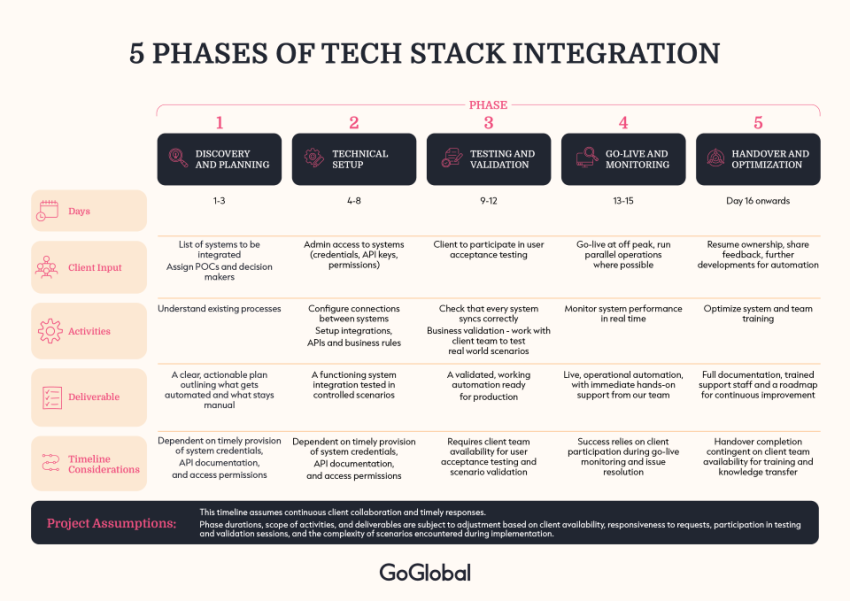
Phase 1: Discovery and planning — mapping the maze
This usually happens days one through three. This is where we roll up our sleeves and get our hands dirty.
Before anything gets automated, we need to understand how your world actually works. Helpful hint: We look at more than what’s written in the SOP.
Every global operation hides the same secret: undocumented, unofficial workflows that keep everything afloat. That one payroll spreadsheet your team swears by. The email chain that’s actually your tax calendar. The manual approval step someone added “just to be safe.”
Our job is to cut through the noise. We look at every system, every step, every dependency. Then, we map how automation will transform the process.
Your role is to be transparent. If something’s broken, tell us. If your teams are using workarounds, show us.
We’re not here to judge. We’re here to fix.
Deliverable: A clear, actionable plan outlining what gets automated and what stays manual (for now). We estimate how long it’ll take.
Skipping this phase is like building a bridge without checking the river depth first. Discovery sets the tone for success.
Phase 2: Technical setup — building the bridge
The next phase days us to days four through eight.
The magic begins here, quietly.
Behind the scenes, we configure connections between your systems. HR talks to payroll. Accounting talks to tax. Data starts flowing securely from one end of your operation to the other.
We set up integrations, APIs and business rules that decide what happens when exceptions occur.
Your role in this phase is to provide access. It seems small but it’s critical. It can sometimes take longer than expected.
We’ll need credentials, API keys and admin permissions to get under the hood. Most of the work happens out of sight. But your timely input keeps the project moving.
Deliverable: A functioning system integration tested in controlled scenarios. Data flows cleanly, securely and predictably.
This phase is far from glamorous but it’s where automation takes shape.
When built right, you’ll barely notice it’s working. That’s the point.
Phase 3: Testing and validation — finding the cracks before you cross
The validation phase usually runs from day nine through 12. We don’t cross the bridge until we’ve tested every plank.
The phase begins with technical checks. We make sure every system syncs correctly. Then comes business validation, where your team steps in to test real-world scenarios. Payroll approvals. Tax calculations. HR updates.
If something doesn’t flow right, we fix it. No guesswork. No shortcuts.
Your role in this phase is to participate in user acceptance testing.
We have you use live data and real examples. You get to test edge cases. This is your moment to stress-test the system before it goes live.
Deliverable: A validated, working automation ready for production.
Skipping testing because “it looks fine” is the fastest way to invite chaos back in.
We’d rather find the cracks now, not after payday.
Phase 4: Go-live and monitoring — turning it on
On days 13 to 15, you’ll experience the moment you’ve been waiting for.
Your systems are connected, tested and ready. It’s time to flip the switch.
We go live carefully, often during off-peak hours to minimize disruption. Then we watch. Closely.
Our job here is monitor system performance in real time. We look to see every transaction, sync and calculation behaves exactly as designed.
Your job here is to start using your new workflows. Report anything that feels off.
Expect a short adjustment period. People need time to trust the new flow after years of manual steps.
Deliverable: Live, operational automation, with immediate hands-on support from our team during the first critical days.
A smooth go-live isn’t luck. It’s the product of careful planning and relentless testing.
Phase 5: Handover and optimization — making it even better
Go-live isn’t the end. It’s the start of a smarter way of working.
Once the system is stable, we shift gears from implementation to optimization. This typically happens on day 16 and beyond, until everything is optimized.
We document everything: every configuration, connection and rule.
We train your team so they can manage day-to-day operations confidently.
We identify improvement areas because automation isn’t static. It evolves with your business.
Your role in this phase is to take ownership. The system is now in your hands. Share feedback. Tell us where automation has created new opportunities, or where it can go further.
Deliverable: Full documentation, trained support staff and a roadmap for continuous improvement.
Automation isn’t a one-time project. It’s a mindset shift, from firefighting to fine-tuning.
What you need before you start
To make your implementation fast and frictionless, come prepared.
Here’s a checklist of action items before implementation:
- Ensure admin access to every system being integrated
- Assign key stakeholders for discovery and testing
- Define clear decision-makers for process changes
- Set realistic timelines based on your complexity
During implementation:
- Show up for discovery and testing sessions
- Respond quickly to access or clarification requests
- Be honest about what works (and what doesn’t)
After your go-live:
- Be patient during the transition
- Keep communication open
- Commit to ongoing refinement
Automation works best when everyone plays their part.
The common questions we get from global teams
“What if something breaks during go-live?”
We expect the unexpected. That’s why we have contingency plans and rollback options ready. Most post-launch issues are small tweaks, not crises.
“Will this disrupt our day-to-day?”
Not much. We plan launches during quiet periods and monitor closely. Any disruption is short-lived. The long-term payoff is massive.
“What if we find new requirements mid-project?”
No problem. Minor scope shifts happen. If something major changes, we’ll rework timelines and options before moving forward.
“How do we know it’s working?”
You’ll see it in your workflow, with fewer manual steps, cleaner data and fewer errors.
We also benchmark key metrics before and after go-live so you can measure the improvement.
Setting realistic expectations
Automation is powerful, but it’s not magic. You should expect progress, but not perfection, on day one.
Typical timeline:
- 2–4 weeks for standard integrations
- Longer if your systems are complex or require heavy customization.
Effort required:
- We handle the tech.
- Your team’s engagement drives success.
Change management:
- Give your team time and space to adapt. Old habits and ways of working don’t vanish overnight.
Continuous improvement:
- Automation is a living system.
- The more you use it, the better it gets.
The payoff: clarity across borders
When global companies automate operations, the shifts are transformative. Manual tasks disappear, errors drop and teams focus on strategy instead of admin.
That’s where GoGlobal’s BlueOcean platform delivers.
Our unified solution brings together global payroll, HR, and compliance across 145+ countries, eliminating the chaos of juggling multiple vendors and systems. With seamless integrations and a single point of contact, you gain the control and clarity you need to scale internationally with confidence.
Ready to optimize your tech stack? Contact us today to see how BlueOcean can streamline your global operations.